
Recognising Emotional Abuse and Coercive Control
-
Author: Krasi Kirova
-
Study time: 8 hours
-
Lifetime Access
-
Video: 6o mins
-
Certificate Available
Limited Early Offer: 20% OFF until 31 October
USE CODE: EARLYOFF20
USE CODE: EARLYOFF20
Does Any of This Sound Familiar?
"Where is the line between a difficult or unhealthy relationship and emotional abuse?"
"How do I know when I should become more concerned?"
"How do I know when I should become more concerned?"
"My client presents with anxiety, depression or trauma… but could there be something in their relationship I am overlooking?"
"What kinds of questions could I be asking to better understand what's happening?"
"How can I distinguish mental health symptoms or attachment difficulties from the effect of ongoing abuse in a relationship?"
"I have seen so many different lists of abusive behaviours or red flags, how do I make them into something practical to use in practice?"
"My client keeps minimising their partner's behaviour. Should I challenge that, or simply stay curious?"
"I think I would recognise obvious abuse, but what are the subtle, everyday behaviours that don't immediately stand out?"
Why This Course Is Essential Even If Domestic Abuse Isn't Your Area of Practice?
Did you know that only 16% of postgraduate psychology programs in Australia include a unit on family violence? As a profession, we are lacking even basic training in this area (The Clinical Psychologist, 2026).
You're already seeing these clients, whether you know it or not
People affected by emotional abuse and coercive control commonly present with anxiety, depression, trauma, relationship difficulties and emotional distress, often without recognising or naming the abuse itself.
There is a significant gap in our training
At the same time, knowledge about domestic violence is becoming an essential professional competency. AHPRA and The Psychology Board of Australia are now calling for family violence education for everyone, recognising it as fundamental to competent practice, rather than an optional area of specialisation.
How you respond can either promote recovery or actively harm clients
Survivors consistently report feeling validated and empowered when therapists understand the dynamics of abuse. Meanwhile, responses that minimise, dismiss or misunderstand their experiences can be re-traumatising, mirror abuse tactics and discourage future help-seeking.
People affected by emotional abuse and coercive control commonly present with anxiety, depression, trauma, relationship difficulties and emotional distress, often without recognising or naming the abuse itself.
There is a significant gap in our training
At the same time, knowledge about domestic violence is becoming an essential professional competency. AHPRA and The Psychology Board of Australia are now calling for family violence education for everyone, recognising it as fundamental to competent practice, rather than an optional area of specialisation.
How you respond can either promote recovery or actively harm clients
Survivors consistently report feeling validated and empowered when therapists understand the dynamics of abuse. Meanwhile, responses that minimise, dismiss or misunderstand their experiences can be re-traumatising, mirror abuse tactics and discourage future help-seeking.
Who Is This Course For?
- Psychologists, counsellors and psychotherapists
- Couples therapists
- Students in Psychology, Counselling and Social Work
- Mental health practitioners
- Social workers and family violence practitioners
Write your awesome label here.
What Makes This Course Unique?
Built for psychologists and counsellors, not caseworkers
Most existing training on coercive control is designed for social workers or family violence practitioners. This course is written specifically for the therapy room. It covers what you need to notice, ask, and formulate, not how to conduct comprehensive risk assessments or provide case management.
Real People. Real Experiences
Woven throughout are insights from an extensive collection of first-hand accounts from people who have experienced coercive control and sought help through therapy. Their voices reveal the realities that theory alone can’t: what helped, what caused harm, what was missed, and what they wish therapists understood.
Application over theory
Every concept is brought to life through realistic therapy scenarios and case examples, then translated into practical questions and approaches you can take straight into the therapy room. The aim is not simply to know more, but to notice more, ask better questions, and apply what you've learned with confidence.
Developed Through Years of My Clinical Practice
Developed by a psychologist who recognised the same training gap many practitioners experience and set out to create the course she wished had existed earlier in her own career. This is a framework that has been stress-tested in the therapy room, not just in academic research.
Teaches pattern recognition and an effective organising framework
The focus is on recognising patterns, context and function, rather than ticking off checklists of behaviours. The 3Ds framework gives you a simple, yet memorable structure (Disrespect, Disempower, Distort) that reflects contemporary research without sacrificing the complexity and messiness of real-life.
Shows, rather than tells
Instead of long chunks of theoretical lessons, the course walks you through a running case study where you have to notice, interpret, and refine your own formulation as new information emerges. This reflects the way information and awareness builds over time in real therapy.
What You'll Get in This Course
Real voices of lived experience
Grounded in current academic research
A case that unfolds step-by-step
Practical reflection exercises
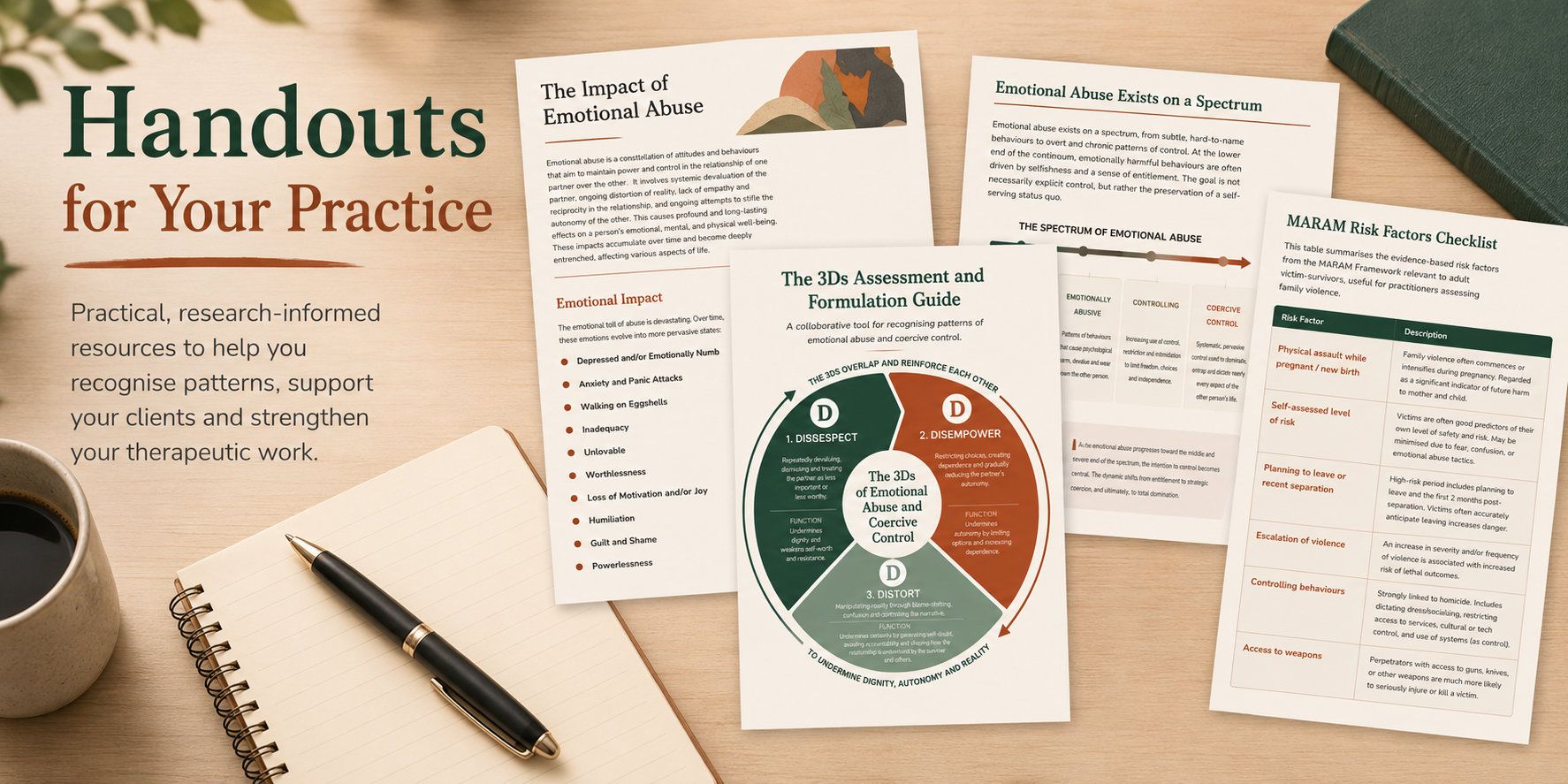
A library of 10 downloadable handouts
A detailed Assessment & Formulation Guide
A list of many further resources
CPD certificate of completion
Learning Outcomes
Course Outline
Your Course Presenter
Krasi Kirova
Krasi is a Clinical Psychologist and Board-Approved Supervisor with extensive training and practice in emotional abuse, coercive control and complex trauma. She provides professional training to psychologists on coercive control and facilitates workshops for women navigating emotional abuse, difficult separations and Family Court proceedings.
Krasi is a member of Safe & Equal, Victoria's peak body for family violence, past participant in their Communities of Practice, and a regular guest on the award-winning Australian podcast The Divorce Course, where she discusses coercive control and post-separation abuse.
Krasi is a member of Safe & Equal, Victoria's peak body for family violence, past participant in their Communities of Practice, and a regular guest on the award-winning Australian podcast The Divorce Course, where she discusses coercive control and post-separation abuse.
Patrick Jones - Course author
Created with